

The AI Strategy Framework I Built for HMCI: Five Layers Every AI-Enabled Business Actually Needs
very organization wants to “do AI.” Few have a framework for what they’re actually building. Here’s the layered approach we use at HMCI.
By Sadie St. Lawrence | Human Machine Collaboration Institute

I want to share something we use internally at HMCI that has become one of the most useful tools for talking to leaders about AI infrastructure.
We call it the AI Strategy Framework.
It started as a sketch on a whiteboard during an early planning session. I was trying to explain to a partner organization why their AI strategy kept stalling, and I drew five horizontal layers stacked on top of each other. By the end of the conversation, we had something useful enough to keep.
A year and a half later, we still use it. It guides how we structure our research at HMCI. It shapes how we advise clients on where to focus. And it has become the clearest way I have found to explain a question that almost every leader is trying to answer right now.
If you want to build a business that genuinely runs on AI, what are you actually building?
The answer is not one thing. It is five layers, and they have to be built in a specific relationship to each other for any of it to work.
Let me walk you through them.
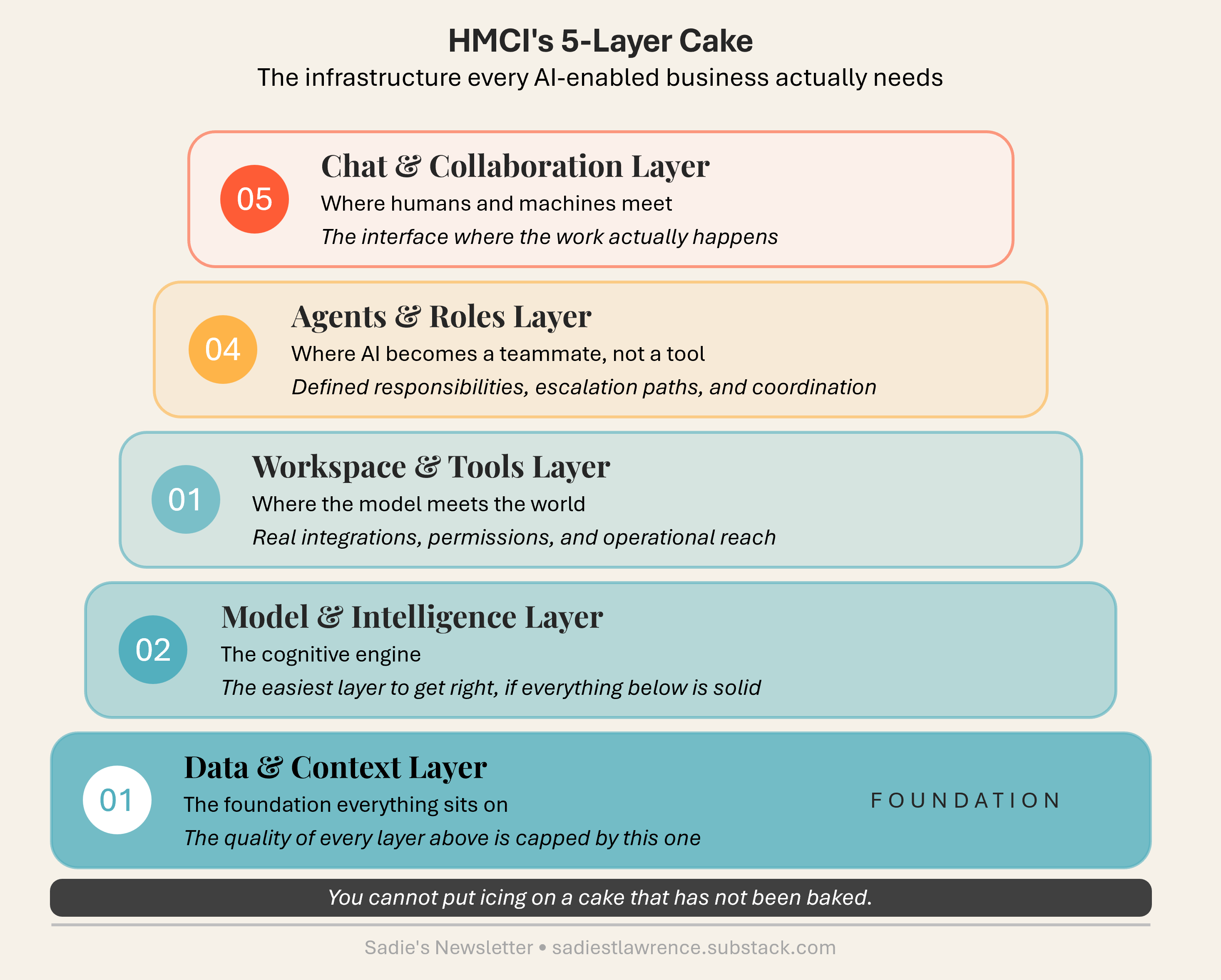
Layer 1: Data and Context
This is the foundation. Everything sits on top of it.
The Data and Context layer is where the information that fuels every other layer lives. It is the structured and unstructured data, the institutional knowledge, the context that gives the AI something real to work with. Without this layer, every layer above it is operating in a vacuum.
Most organizations radically underinvest here. They want to talk about models and agents and chat interfaces, which are visible and exciting. They do not want to talk about data quality, governance, taxonomy, and the unglamorous work of making information available and trustworthy at scale.
But here is the rule that has held in every engagement I have run. The quality of every layer above this one is capped by the quality of this layer. You cannot build a sophisticated agent on top of disorganized data. You cannot deploy intelligent workflows on top of inconsistent context. You can try, and many organizations do, but the system will inherit every flaw in the foundation and amplify it.
What success looks like at Layer 1: data is structured, accessible, governed, and contextual. The AI has something real to learn from and reason against.
Layer 2: Model and Intelligence
This is the layer most people think of when they hear the word AI.
The Model and Intelligence layer is the cognitive engine. It is the large language models, the specialized models, the reasoning systems, the embeddings and retrieval mechanisms that turn data into something usable. It is the part that gets the press releases and the keynote slides.
Here is the counterintuitive truth about this layer. It is the easiest layer to get right.
The models that exist today are extraordinary. The frontier capabilities are accessible through APIs that any organization can use. The choice between providers is not as consequential as most teams treat it. What matters at this layer is not picking the perfect model. It is connecting the model thoughtfully to the layer below and the layers above.
I see organizations spend months agonizing over model selection while the data layer beneath it remains broken and the workflows above it remain undesigned. That is the wrong order of operations. The model is the engine. The rest of the car still has to exist.
What success looks like at Layer 2: appropriate intelligence is available where it is needed, with the right tradeoffs between cost, latency, capability, and oversight.
Layer 3: Workspace and Tools
This is the layer where the model meets the world.
The Workspace and Tools layer is where the AI can actually do things. Where it can access calendars, databases, code repositories, customer records, communication systems, and the operational surface area of the business. It is the layer that turns the AI from a thinking partner into a working partner.
This is also where most of the practical complexity lives. Tools have to be integrated. Permissions have to be set. Boundaries have to be defined. The AI needs to know what it is allowed to touch, what it is allowed to change, and what requires a human signature before action.
When this layer is missing, you get demos. Beautiful, articulate, smart demos. But the AI cannot actually do anything. The conversations are sophisticated and the outputs are well-reasoned and nothing in the organization changes as a result.
What success looks like at Layer 3: the AI can take action in the real systems of the business, with appropriate permissions and clear boundaries.
Layer 4: Agents and Roles
This is where the architecture starts to feel alive.
The Agents and Roles layer is where you stop thinking about the AI as a tool and start thinking about it as a teammate. Specific agents with defined responsibilities. Roles with clear scope, decision authority, and escalation paths. Workflows where multiple agents coordinate to accomplish something none of them could do alone.
This is the layer most organizations are aspiring to right now, and most of them are getting it wrong. The mistake is treating agents as features rather than as roles. Features are technical components. Roles are organizational concepts. You design roles before you build the people, or in this case the agents, who will fill them.
The organizations that succeed at this layer treat the design of an agent the same way they treat the design of a job description. What is the agent responsible for. What does success look like. Who does it report to. What does it escalate. What does it not touch. The technical implementation comes second.
What success looks like at Layer 4: defined agentic roles with clear scope, working alongside humans in defined relationships.
Layer 5: Chat and Collaboration
This is the top of the cake. The layer where humans and machines actually meet.
The Chat and Collaboration layer is the interface where the work happens. It is where a person can talk to a system that understands them, draws on the layers below, and produces something genuinely useful. It is the conversational, collaborative surface that everything else makes possible.
This layer gets a disproportionate amount of attention in product marketing and a disproportionately small amount of attention in actual organizational implementation. People see the chat interface and assume that is what AI is. It is not. It is the visible part of a much larger architecture, and the quality of the experience at this layer is determined entirely by how well the four layers below it have been built.
A chat interface on top of a broken data layer is a sophisticated way to be wrong. A chat interface on top of a well-built stack is the most powerful productivity surface most organizations have ever had access to.
What success looks like at Layer 5: humans and machines collaborate naturally on real work, in real time, with the full intelligence of the stack available to them.
Why the Cake Metaphor Matters
You can call this any number of things. A stack. An architecture. A framework. We landed on cake because the metaphor does something important: it forces you to think about the layers in relationship to each other.
You cannot ice a cake that has not been baked. You cannot bake a cake on a foundation that has not been mixed. The layers depend on each other in a specific order, and shortcuts at the lower layers always show up as problems at the higher ones.
The organizations that are succeeding with AI right now are the ones that understand this. They are not racing to deploy the top layer. They are working through the foundation, the intelligence, and the tools deliberately, in the right order, so that when they finally surface to the chat and collaboration layer, the experience is real instead of performative.
This is the difference between AI as theater and AI as infrastructure. And it is the question I want every leader reading this to sit with.
Where in this five-layer cake is your organization actually strong, and where are you trying to build the top before the foundation is set?
A Note on the Work Ahead
At HMCI, our research is increasingly organized around these five layers. We are studying what makes each layer succeed and what makes it fail. We are mapping where organizations get stuck and what unsticks them. And we are working on tools and frameworks that help leaders diagnose their own stack honestly.
If this resonates with you, the full architecture and the playbook for working through each layer in your own organization is something I cover in depth in Becoming An AI Orchestrator. The orchestration skill exists at every layer, and the book is structured to help you build it across all five.
Which layer is your organization strongest at, and which is the one that keeps you up at night? Hit reply and tell me. I am collecting data on where organizations are actually struggling in this stack and your honest answer matters more than you know.

Sadie St. Lawrence is the Founder & CEO of the Human Machine Collaboration Institute and author of Becoming an AI Orchestrator. She writes weekly about the future of human-machine collaboration, AI in practice, and what it actually takes to build at the frontier.
Great insights Sadie....